Burp 12
Returned to Selepswe for the night. Again we got personal service from the lovely staff. The first night I tried the local delicacy ‘swana beef’ which is boiled beef pounded until it is shredded like a pulled pork. It was very tender and the locals consume high levels of meat so servings are large. So the second night I went for the fish which was a whole grilled perch – also tasty. Next morning there was a problem when we checked out to pay for meals- they were so new, they didn’t have credit card facilities and we had little cash! However, they gave us a receipt and asked us to drive to the nearest ATM at Bobanong and give the payment to a local who we would ring and meet him; very trusting but it all worked in the end. It is a very cash based culture with long queues at ATMs everywhere. It can take half an hour to queue at times.
Then we drove to Goo-Moremi Gorge. Written instructions were poor at best. Google maps, Waze, etc likewise. The most reliable directions were found on ‘Tracks4Africa’ and this failed us here as well. We got to the village of Moremi (I think Goo means gorge) and it was a typical Botswana village – no appreciable layout and winding tracks of deep sand between houses, couldn’t find our way through this to find the resort at the gorge.
The concept of land and house ownership is very different to our western view. The tribe owns all the land in the area and allocates around half a hectare to any tribal family around the edge of a village as it grows. This is for the whole extended family but is not owned by any individuals, it is more like a right to occupy from the tribe . It is fenced and every bit of vegetation is removed and the red dust is raked often (except for any shade trees which then have cars parked under them). Possibly any vegetation could hide or encourage undesirable creepy crawlies near the houses. The government will provide house plans and deliver building materials (concrete block and corrugated iron with an aluminium window and wooden door) to the site for free whenever they are requested. The villagers pitch in on construction, but they are usually unskilled and the results are shoddy and many are unfinished. The plan is a box of about 25sqm – for sleeping. Each site will have a separate long drop and a roofed, partially enclosed open fire for cooking. All meals in the dry season are cooked and eaten communally and in the wet they use a gas cooking ring. Firewood is a currency here.
Men must provide a house for a prospective bride before they can marry. The brides family pays a dowry ranging from 17 cows for the eldest daughter down to 8 cows for the youngest (the youngest daughter is expected to take care of the parents, so comes with ‘baggage’!). The dowry is negotiable. Families are often split up when work opportunities for the men happen in other areas and there is a lot of commuting on weekends etc. There is a bus service but it is sparse and all people waiting for a bus will try to flag you down for a ride. The children are delightful- education is highly valued and they are immaculately dressed in their school uniforms and smile and wave. Every woman has a unique hairstyle and colour (except blonde) – often braided in cornrows. Sometimes these are short and fine in various geometric patterns and sometimes left very long or wound into intricate buns and topknots; very stylish and proud.
Anyway I digress. We found a bakery in Moremi and I stopped to ask directions. I bought 6 scones for 12 pula but I gave her 50 pula ($nz 5). There was another customer in the shop who said he would take us as directions were too complicated. Twenty minutes later and after a ‘once again’ rough road we got there. He did not want a ride back to the village so I gave him 50 pula as well.
It was a very special resort with a view across the gorge to high hills beyond in the setting sun from the restaurant balcony. The reputation was for wildlife again at the river but a guide was essential and it was too late for us. However we enjoyed the sunset and the half km walk back to chalet in the dark (very brave).
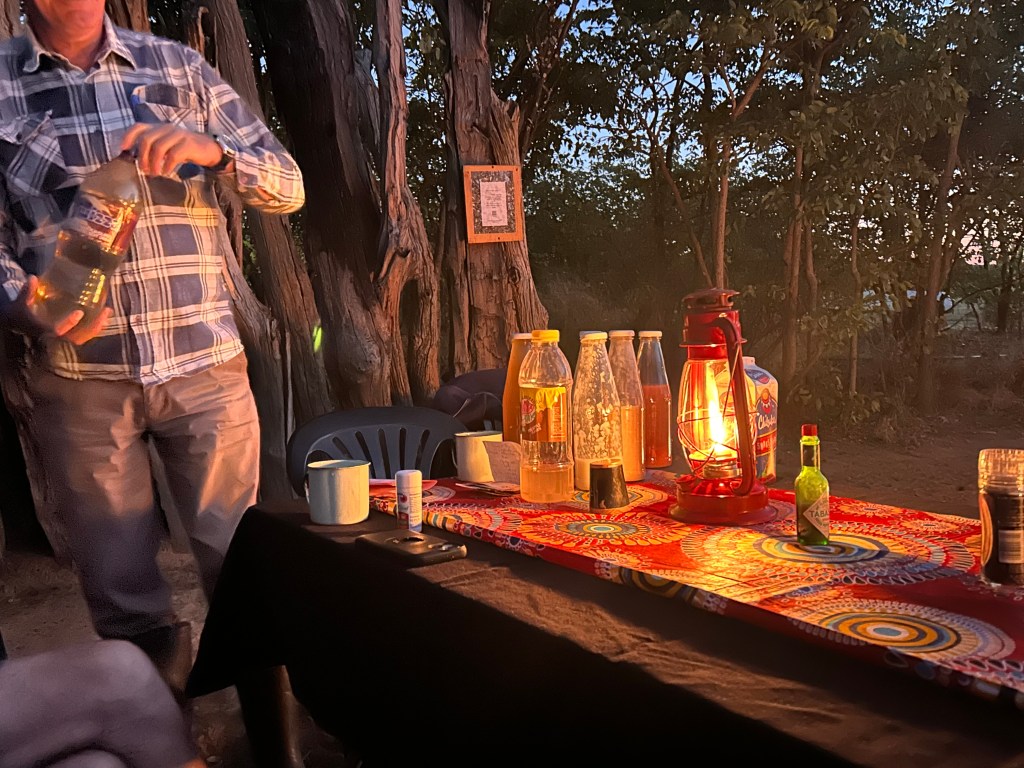
Next day we drove on for our last night at our hosts farm – of course getting lost again, but we did make it eventually. Graeme and Gillian are very knowledgeable and friendly hosts and gave us a great welcome. Their local chef ‘Bame’ showed me the locally gathered components of our meal she was preparing over a fire – including dried Mopane grubs (like Huhu grubs), various berries and nuts. All meals have a starch component called pap which is a dollop of ground maize flour which I found tasteless and stodgy (I always chose fries). But we had swana beef (which I had prepared in the traditional way) and all the foods we had seen earlier and added chicken feet. Just as well it was dark and we couldn’t see very well! The meal was followed by a tasting of a range of local bootleg alcoholic beverages then some gins and nice Sth African pinotage 😁😁
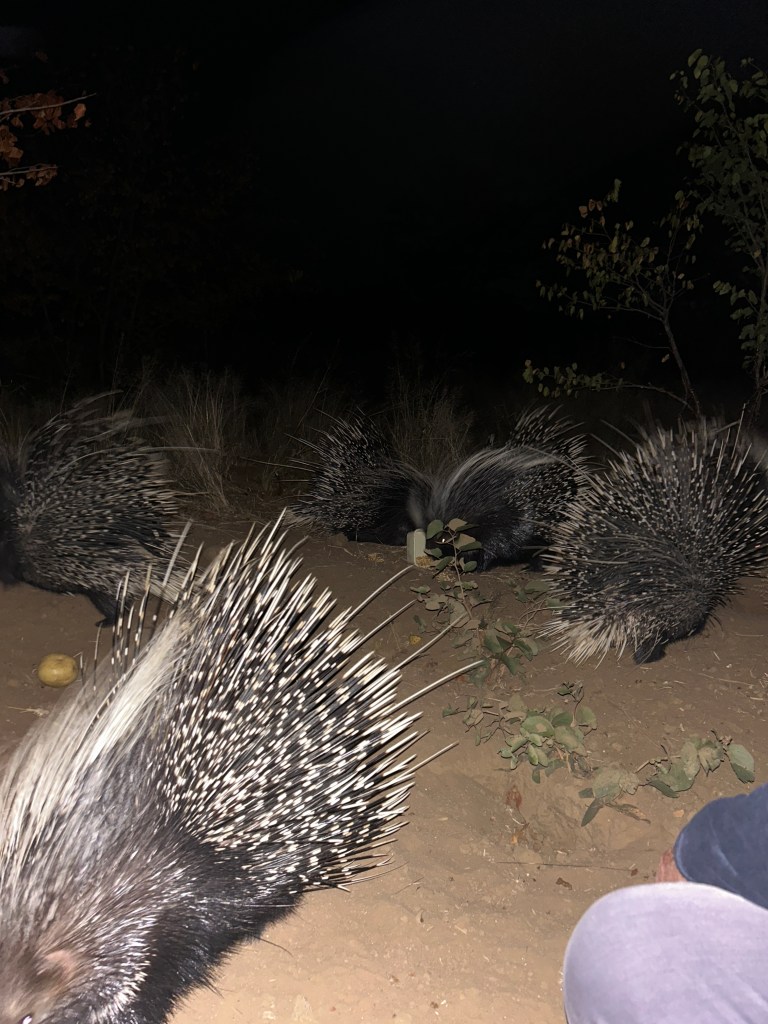
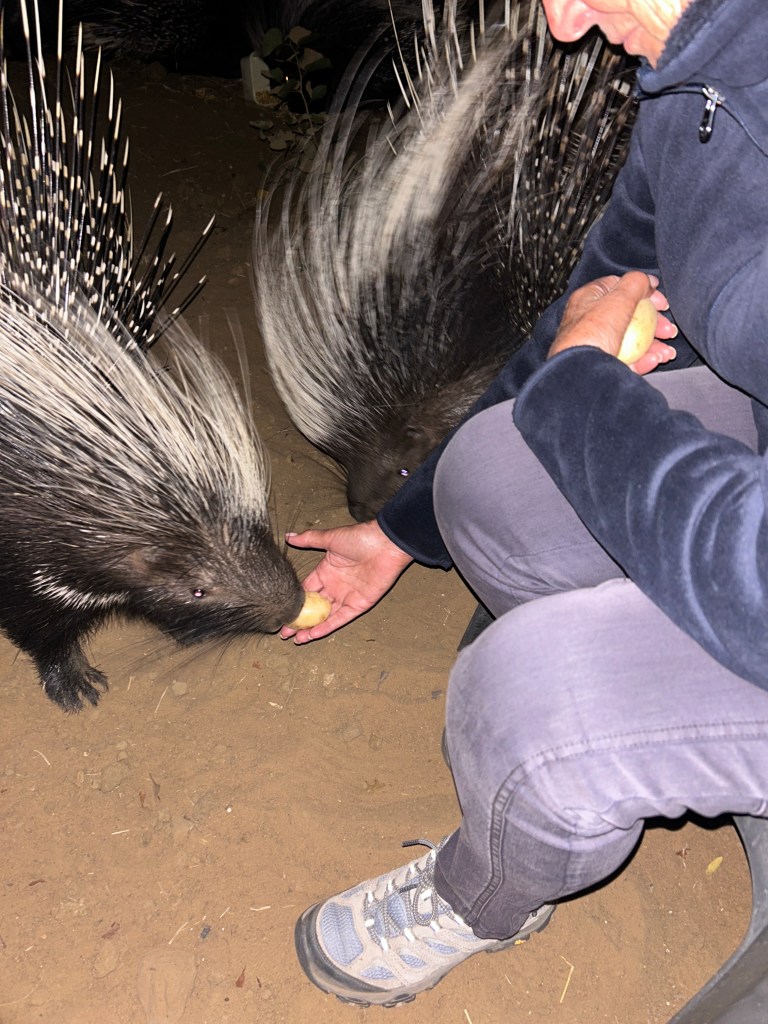
We finished the evening with one of the highlights of our trip- Graeme took us to see his human habituated Porcupine family. There is a family of 6 of these beautiful nocturnal creatures which he has in a fenced enclosure to protect them as they are endangered. He feeds them every night with raw potatoes, apples, small melons, maize and dog biscuits which he scatters in different locations. We sat down on chairs by torchlight and it wasn’t long before we heard a sound like swinging grass skirts at poi dance and this amazing vision came into view of large black and white sails swept into view. They are rodents (but think medium dog sized black rabbits) with a halo of black and white quills which tremble and expand and contact depending on how comfortable the porcupine is. There were some heated exchanges over who was entitled to some morsel of food. They also sport a large white Mohawk-like hairstyle from their nose to their quills. After a short period of getting used to us and circling around, they moved in and started eating apples (a treat for them) and potatoes from Joy’s open hand. She was delighted and captivated and they responded well to her according to Graeme.
Next day we said our goodbyes and set out for our final stop, where we started in Gaborone. There have been several Police and veterinary checkpoints along the way, none of which caused any consternation and we usually just got waved through. However, not long after hitting the road, there was another one and the Police were just waving us through when he did a double take and made us pull over.☹️. He had noticed that the car registration had expired at the end of May and it was now 4 June! My options it was explained to me very tersely were to pay a fine or have the car impounded immediately. It did not matter that it was a rental, I was the driver of said unlicensed vehicle. Fume!! Fine 500 pula (second black mark with the Botswana constabulary). It was a genuine situation and not a scam and I have the paperwork to prove it.
We generally found all Botswanian people to be honest friendly and willing to help whenever they can. But there was a conversation to be had with the rental car company. Apparently the new registration was in the file but because we had rented the car in April and didn’t return it till June, they had overlooked changing it when we left. We did 4,846 km on our journey with 2 speeding incidents and a misdemeanour.
We said goodbye to Botswana and flew to Johannesburg and caught our Qatar flight to Doha where we have spent the day reclining by the pool in the desert heat- what a wonderful wind down. And now we are getting ready to board the next flight to NZ (only 17 hrs this time) and looking apprehensively at the weather expecting snow and road closures before we get back on Sunday (or maybe Monday at this rate😖)
Maybe a final blog to finish and some other photos we haven’t had space to include when we get there. Bye for now.


 Botyburps
Leave a reply to affable7e3756fe3e Cancel reply